


The Zhang Family
Mr Zhiguang Zhang and his 13-year-old son Bubble enjoy playing chase in the park. Bubble loves to laugh. His world is simple and pure, and the smallest things can keep him happy for half a day. Mr. Zhang brings deep expertise in big data, holds a Master’s degree in engineering, and has successfully built two start‑ups that were later acquired. His commitment to innovation and his lived experience as a father shape the thoughtful, forward‑looking support he offers to our work.
Founded by Three Autistic Families
Alsolife began with three autistic families in China who wanted a future that honours their children’s strengths and potential. From these humble beginnings, we’ve grown into a sustainable mission supporting more than 430,000 autistic families across China and beyond. Their lived experiences continue to guide our values of respect, empowerment, and community.

The Liu Family
Kexin and Keyi are 19 years old. Their father, Mr. Daiyue Liu, shares quiet, meaningful moments with his twin daughters, who are autistic and do not use speech. A gentle lean on his shoulder, a clear‑eyed smile, or the younger sister picking a tiny peach blossom for him to tuck into her braid—these small gestures bring him deep joy. Mr. Liu is a former Fortune 500 executive and holds a Master’s degree in Psychology. He's now Headmaster Liu, leading several of our special schools, where he brings both professional expertise and lived experience as a father.

The Chen Family
Beibei and Baobao are 20 years old. Their father, Dr. Chen Weijing, remembers the early days after their diagnosis, when the family worried that the boys might never understand how deeply they were loved. They rarely looked toward him, and love felt distant and uncertain. Then one evening, as Dr. Chen returned home from work, the twins heard his footsteps on the stairs. They opened the door and called out to him, welcoming him home. In that moment, he understood that their love had always been there, expressed in their own way. Dr. Chen is a Professor at a leading Chinese medical university, and holds a PhD in Molecular Biology. His scientific expertise and lived experience as a parent guide our research and practices.
Celebrate Neurodivergent Learners
These moments show autistic and neurodivergent children engaging with AI Language Bot (AI Chat and 1-On-1 Practice) in ways that honour their strengths, interests, and natural learning rhythms.


Real-time LLM driven conversational practice
Building social skills through play-based tasks
A walk-through of AI Language Bot
A personal therapist at home
AI-Powered Programs
AI Language Bot
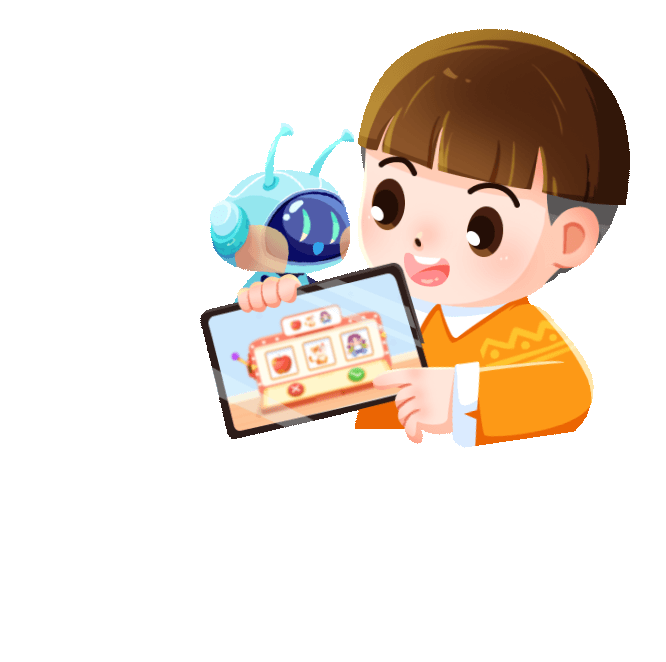
A scalable, data‑rich learning system designed for neurodivergent learners. Learn how AI Language Bot enhances teaching efficiency, supports consistent practice, and provides actionable developmental insights.
1-On-1 Practice

A scalable 1‑on‑1 learning system that delivers individualized practice for every child while reducing staff workload and improving outcomes.
AI Chat with Maya
.jpg)
A dynamic AI chat system that guides realistic social exchanges, supports emotional understanding, and strengthens communication skills through natural, child‑led interaction.
AI Characters

A small community of warm, supportive AI characters who help children feel understood and engaged—at their own pace, in their own way.
DATA-DRIVEN SOLUTIONS • EVIDENCE-BASED RESEARCH • INNOVATION • SCIENCE-LED • DATA-DRIVEN SOLUTIONS • EVIDENCE-BASED RESEARCH • INNOVATION •
R&D Innovation
We believe every piece of data collected helps us understand needs more accurately, empowering families with more possibilities. Our flagship research projects bridge the gap between clinical evidence and daily family life.
Using longitudinal caregiver‑reported data from birth to age three, this study examines expressive language, joint attention, and social pretend play across autistic and non‑autistic children. Findings highlight meaningful developmental differences—especially in joint attention for boys and social pretend play for girls—offering insights that support more inclusive educational and diagnostic approaches.
Analyzing 26 empirical studies, this review evaluates the psychometric performance, observed indicators, and methodological rigor of telehealth applications for autism screening and diagnosis. Sensitivity ranged from 0.70 to 1.00 across tools, with several demonstrating strong diagnostic agreement with in‑person assessments. The review identifies promising technologies and key areas for future validation.
Using national longitudinal data, this study examines how different forms of symbolic play at age three—solitary pretend play, object substitution, and peer role play—relate to later language outcomes in autistic and non‑autistic children. For autistic children, early symbolic play showed strong, significant links to age‑seven semantics, syntax, and narrative abilities, with object substitution emerging as the most influential predictor. These patterns were not observed in non‑autistic children, for whom socioeconomic factors and early language skills were more predictive. The findings highlight the unique developmental value of symbolic play for autistic children and underscore its importance in designing affirming, play‑based language interventions.
This large‑scale study evaluates the psychometric reliability and validity of the ALSOLIFE Assessment—a free, technology‑supported, caregiver‑operated system designed to capture autistic children’s everyday learning, social engagement, and adaptive skills. Drawing on data from 1,050 children across 31 provinces in China, the assessment demonstrated strong internal consistency, test–retest reliability, inter‑rater reliability, and robust criterion validity against VB‑MAPP and PEP‑3. Factor analyses supported a bifactor model reflecting one general developmental factor and six skill domains. The findings affirm the ALSOLIFE Assessment as a comprehensive, culturally grounded, and family‑centered tool that supports caregivers in delivering individualized, home‑based intervention aligned with the ALSO conception.